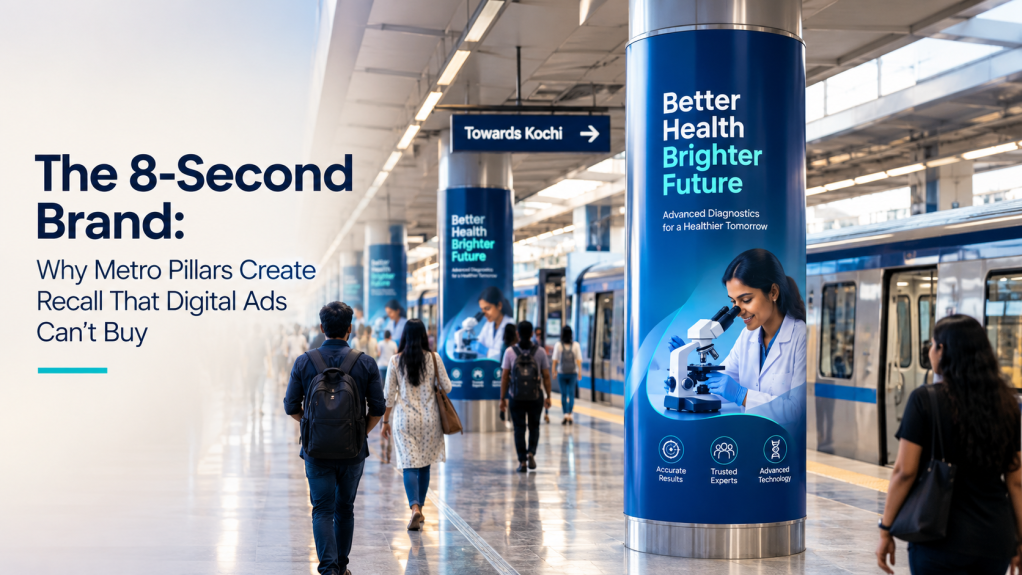
The 8-Second Brand: Why Metro Pillars Create Recall That Digital Ads Can't Buy
1. Making Every Second Count
A metro pillar advertisement does not have much time to get its message across. People are walking or looking for directions. They do not have time to stop and read a long advertisement and it must make sense while people are on the move.
That calls for a creative approach built around clarity rather than quantity. A few elements can make the difference:
- A strong headline: Give commuters one idea they can understand quickly.
- A memorable visual: Use imagery that catches attention and supports the message.
- Clear branding: Make the brand name easy to recognise.
- Minimal copy: Keep supporting information short and readable from a suitable distance.
It is not necessary for a pillar to communicate all about a business. What is required is that it conveys something that should be remembered. This is where the true potential lies – what if the very same individuals come across this message again tomorrow?
2. When One Glance Becomes Familiarity
Now think about walking past a pillar with the same advertisement during your daily commute. The first time around, you notice its colours. After a few days, you start feeling familiar with the brand name. After a few exposures, you might be able to recognize the brand before even reading the complete message.
This is how Kochi metro advertising pillars can help in marketing a brand outside as well. Strategic placement of pillars can ensure that the commuter gets exposed to the same brand multiple times while commuting.
For example, an advertiser who opens up a new store may make use of pillars to advertise his products on the routes which his probable customers take. This initial exposure will make known the name of the brand, and repeated exposures will definitely help people remember the name while purchasing.
Familiarity is, however, not enough. Familiarity with the advertisement by those who do not intend to buy anything will definitely result in failure. It is imperative to first decide where the brand is to be viewed before determining the frequency of viewing it.
3. Choosing Pillar Locations with a Purpose
Each metro pillar does not have an equal potential for advertisement. There are factors that can determine whether commuters will see the advertisement or ignore it completely.
Before selecting placements, businesses should consider:
- Audience relevance: Do the commuter routes align with the people you want to reach?
- Visibility: Can the advertisement be seen clearly as people move through the area?
- Viewing distance: Will the headline and main visual be easy to understand at a glance?
- Campaign coverage: Would a few carefully selected pillars or a wider set of placements better suit your objective?
These considerations help businesses look beyond footfall figures and think about the value of each placement. But even a well-positioned pillar can lose its impact if every advertisement in the campaign looks and sounds different. That brings us to the next part of the puzzle: consistency.
4. Making Multiple Pillars Work Together
Imagine seeing a brand across several pillars, each carrying the same colours, recognisable visual identity and central message. Rather than encountering unrelated advertisements, commuters begin to see a consistent brand presence.
To build that connection:
- Maintain the same core brand identity across placements.
- Repeat the central message throughout the campaign.
- Keep the brand name prominent in every creative.
- Adapt supporting content only when it strengthens the campaign objective.
Consistency becomes a factor in the integration of the different experiences, but in the development of the advertisement campaign, it is essential to do more than maintaining consistency in terms of the design. It becomes important to coordinate the places, the art, the production, permission procedures, and installation procedures. It is at this stage that an advertisement agency for the Kochi metro may be useful in helping to coordinate all these and selecting the most appropriate one according to the aim and budget of the campaign.
After these issues are resolved in terms of location, duration, budget and permissions of the campaign, attention should be paid to the one more issue that remains before proceeding further – the goal that the campaign should meet. It is not about the timing of advertisements; it is rather about their effect on brand awareness and recall.
Final Thought: What Will People Remember?
While each encounter with a metro pillar may last for a short amount of time, there is an opportunity for it to develop into something more. A good message can ensure that the advertisement is comprehensible to the target audience, a good placement ensures proximity, and good creative helps with recognition.
Before investing in metro pillar advertising, ask yourself three questions:
- Will the right people see the advertisement?
- Can they understand its message in a few seconds?
- Will they recognise the brand when they encounter it again?
The value of a pillar campaign is not measured only by how many people pass it. It also lies in the opportunity to make a brand familiar enough to come to mind when a relevant need arises. After all, an advertisement may occupy a pillar for a few weeks, but the real aim is to leave something behind in the minds of the people who pass it.